

McKinsey just released The State of Fashion 2026 report.
One line in it changes everything.
AI shifted from a competitive edge to a business necessity.
Not a tool. Not a feature. Infrastructure.
The Signal
35% of brands use AI now. The rest are learning the hard way.

In November 2025, McKinsey and The Business of Fashion published their annual State of Fashion 2026 report.
Here's what happened:
Executives cite AI as the biggest opportunity for the fashion industry. Not second place. Not tied with something else. The top priority.
AI now ranks higher than:
Product differentiation
Sustainability
Brand building
Customer experience
Everything else dropped below it.
McKinsey says it directly: "AI is shifting from a competitive edge to a business necessity."
Here's why this matters.
The fashion business model is breaking. Costs are volatile. Supply chains are disrupted. Growth is slow. The report says companies must redesign their processes and reshape workforces around AI.
Not add AI to existing jobs. Rebuild jobs around AI.
35% of fashion executives already use generative AI for customer service, content creation, product discovery, and marketing.
23% of consumers now use AI to discover new products.
This isn't future talk. It's happening right now.
And the urgency is real. 46% of fashion executives expect conditions to worsen in 2026. Nearly half the industry thinks next year will be harder than this year.
The brands that survive won't be the ones with better taste. They'll be the ones that move faster.
AI is the speed layer.
The Playbook
So what does this actually mean for you?
Three things to do right now:
1. Stop thinking about AI as a tool. Start thinking about it as your operating system.
McKinsey says companies must "redesign their processes" around AI.
That means you don't add AI to your current workflow. You rebuild the workflow around what AI makes possible.
Example: Your team creates 10 product descriptions per day. With AI, they could create 100. But if your review process still assumes 10, nothing changes.
Fix the process. Not just the output.
2. Turn existing roles into AI-native roles
The report says "existing jobs are becoming more AI-centric."
That's the shift. Your merchandiser isn't just picking products anymore. They're training AI on what good looks like.
Your designer isn't just creating. They're curating what AI generates.
Create new role descriptions:
AI Product Curator (teaches AI, picks winners)
AI Trend Analyst (trains models on brand aesthetic)
AI Content Director (manages AI-generated assets)
These aren't tech jobs. They're fashion jobs that use AI as the base layer.
3. Hire AI talent from outside fashion
McKinsey is direct: "Compete for AI talent, looking beyond the fashion ecosystem."
The talent doesn't exist inside fashion yet. You need to go find it.
Hire from tech. From gaming. From media. People who know AI tools but need to learn fashion.
It's easier to teach fashion to someone who knows AI than to teach AI to someone who knows fashion.
The Runway Reel
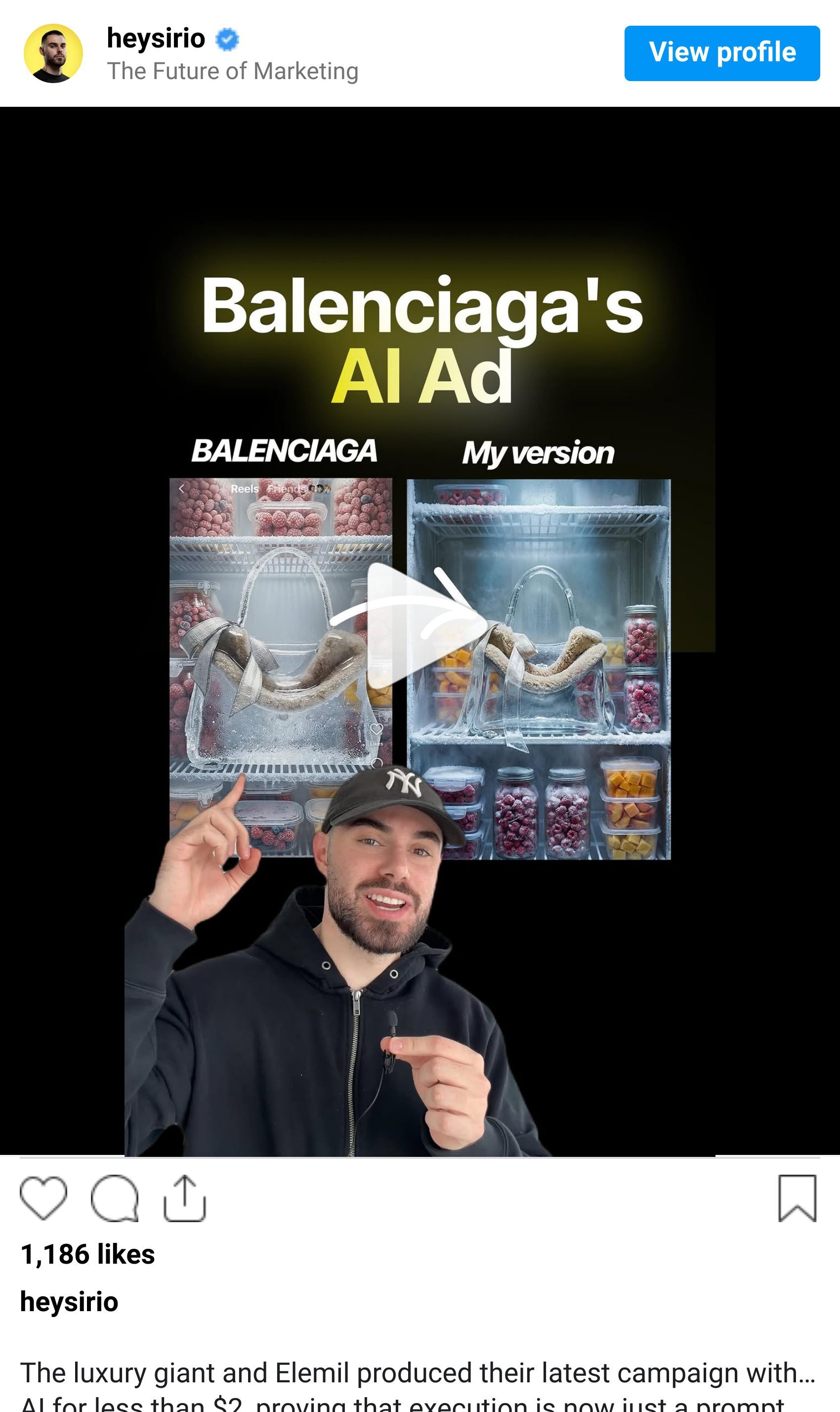
Even Balenciaga is on the AI train
AI Updates
1. Meta launched "Conversation Focus" for Ray-Ban AI glasses (Dec 17)
Impact: Smart eyewear is going mainstream. If you're in fashion accessories or wearables, this category is about to explode—sales expected to quadruple in 2026.
2. TIME named "Architects of AI" Person of the Year (Dec 12)
Impact: AI moved from tech novelty to cultural infrastructure. Your customers now expect AI features. Not having them makes you look outdated.
3. OpenAI released GPT-5.2 with three professional-grade versions (Dec 15)
Impact: AI just became your design assistant, merchandising analyst, and content producer. The tools are production-ready. Your competitors are using them right now.
I found this interesting
I’ve admired and followed Ryan Deiss since the last 5-7 years
A Final Note
LET'S TALK
McKinsey says 35% of fashion companies already use AI for operations.
Do you think your competitors are in that 35%?
And if they are, what does that mean for you?
Hit reply and tell me what you think.
Let me know what you thought of this edition.Until next time,

